Safety stock is the extra inventory that protects you when demand rises or the supplier is late. Too little means stock-outs; too much ties up cash.
Method 1: Max-min (simple)
Safety stock = (Max daily sales × Max lead time) − (Average daily sales × Average lead time)
| Input | Value |
|---|---|
| Max daily sales | 30 |
| Max lead time | 10 days |
| Average daily sales | 20 |
| Average lead time | 7 days |
| Safety stock | (30 × 10) − (20 × 7) = 160 |
It is easy but sensitive to a single extreme day.
Method 2: Statistical (service level)
Safety stock = Z × σ(daily demand) × √(Lead time)
Z is the service-level factor: about 1.28 for 90%, 1.65 for 95% and 2.33 for 99%. σ is the standard deviation of daily demand, and lead time is in days.
| Input | Value |
|---|---|
| Service level | 95% (Z = 1.65) |
| Std deviation of daily demand | 8 units |
| Lead time | 9 days (√9 = 3) |
| Safety stock | 1.65 × 8 × 3 = about 40 units |
If lead time varies too
Add the variability of lead time to the formula, or use the longest realistic lead time. Keep your actual supplier receipts as the source.
Choosing a service level
A 99% service level costs far more stock than 95%. Set higher levels for A-class and critical items and lower for C-class (see ABC analysis).
In NexoraIMS
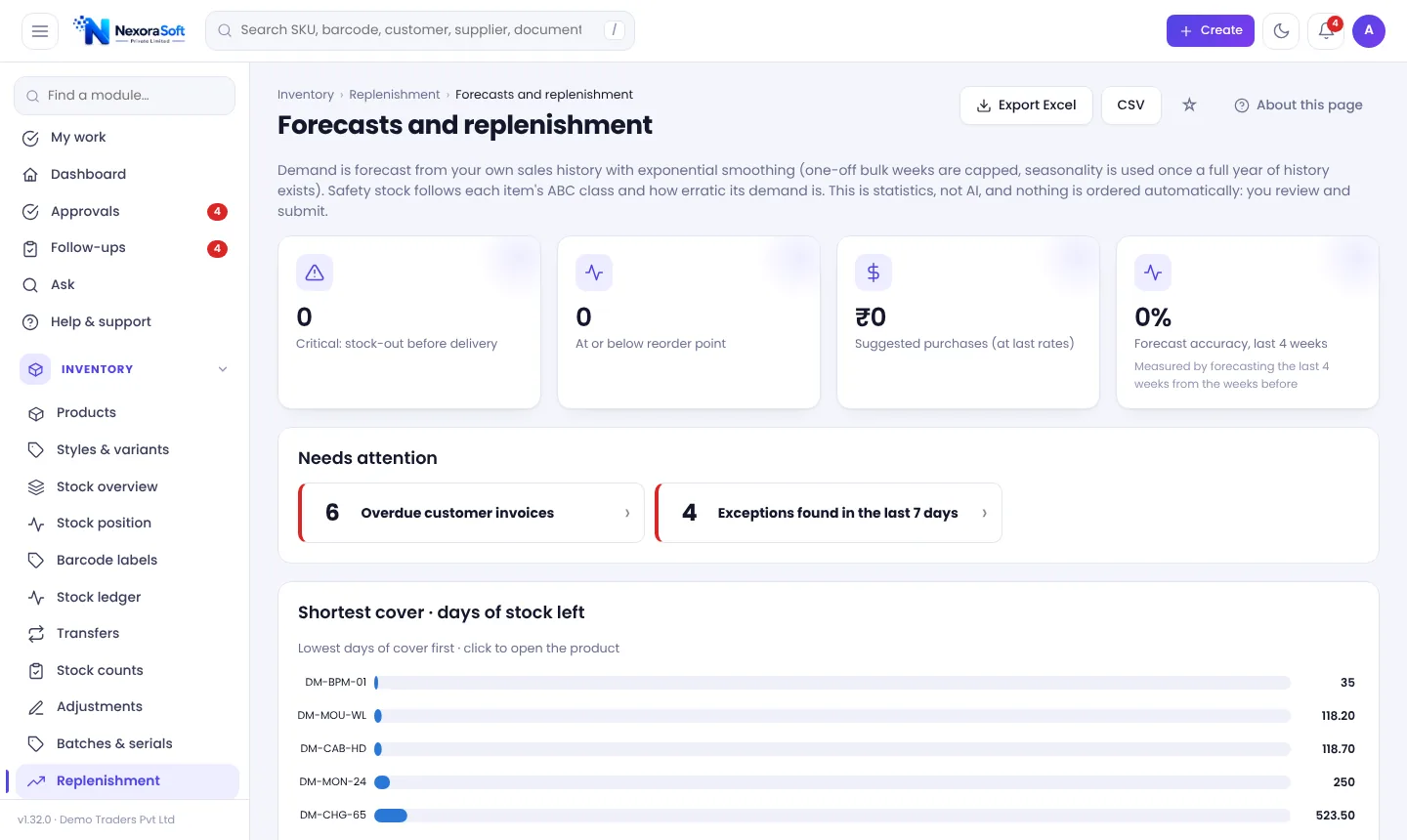
Service levels, review cycle and default lead time are set under Planning settings on the Forecasts and replenishment page, where the system estimates demand from your own sales history. These are estimates; review them. See reorder point software and how to calculate reorder point.
Related guides: Inventory Management Software in India (complete guide)
Reorder Point & Replenishment SoftwarePurchase Order Management SoftwareInventory Analytics & ABC AnalysisHow to Calculate Reorder PointABC Analysis in InventoryInventory Turnover Ratio
See NexoraIMS in Action
Book a free live demo and see stock, purchasing, GST billing and reports run on your own products.
Book a Free Demo +91 98115 51004